
- Published on
How Minekube AI support closes the feedback loop
- Authors

- Name
- Robin Brämer
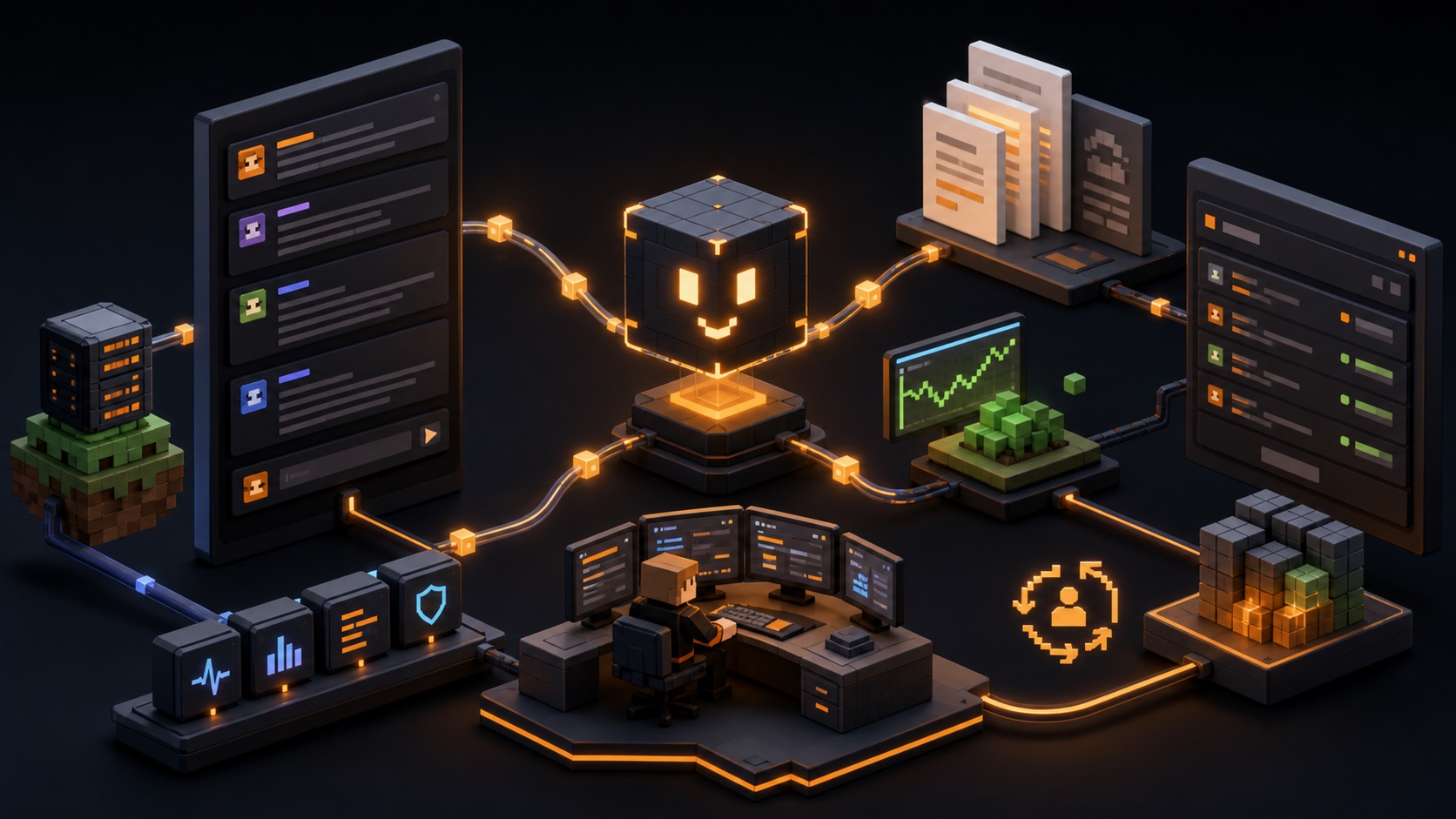
Minekube AI support in Discord is already helping server owners debug Connect setup while turning repeated issues into better docs, product signals, and engineering fixes.
The first live Minekube control-plane loop is support.
Server owners come to the Minekube Discord when something is unclear: a connector will not authenticate, a domain does not resolve, Bedrock players see a different failure than Java players, or a proxy forwarding setup behaves differently than expected.
Minekube's first-level AI support agent now handles the first pass in Discord. It has graduated from beta to stable, and it already answers common setup questions, points people to the right compatibility docs, asks for missing context, finds similar cases, and helps narrow down whether an issue is likely in Connect ingress, the connector, proxy forwarding, backend auth, DNS, or Bedrock translation.
This is not separate from the product. It is the first visible version of the Minekube control plane learning from real server operations.
What the support loop does
A good support loop does three jobs:
- helps the server owner make progress right now,
- captures product signals about what is confusing or broken,
- and routes the hard cases back to humans and engineering.
That is what the support agent is starting to do. It can explain setup steps, compare a user's situation to docs and similar cases, ask for logs or configuration details, and suggest the next safe diagnostic step.
Human support does not go away. Support staff still see support activity, and critical, confusing, unsafe, or unresolved cases remain visible to the people who can fix them.
The important change is that the first response no longer needs to be a generic "send logs" message. It can be product-aware, docs-aware, and specific to the shape of the Minekube Connect setup.
What the archive shows
The support archive shows how much this already matters.
From November 2, 2025 through July 2, 2026, the ask-support forum captured 387 threads, 6,885 messages, and 254 distinct participants. In the last 30 days of that archive, there were 61 support threads and 1,832 messages. Minekube AI posted 4,563 messages across those archived threads.
A conservative text search found source-grounded diagnostic answers in 66 threads and at least 69 threads with explicit success or thanks markers from users.
Those numbers are not vanity metrics. They tell us that server owners are already willing to debug with Minekube AI, that the agent is useful enough to stay in the workflow, and that support threads are becoming a map of what the product should explain or automate next.
Real cases, concrete fixes
The useful cases are often concrete and technical.
The agent has helped identify missing or invalid endpoint tokens behind 401 Unauthorized errors. It has separated backend plugin issues from Connect routing issues. It has explained when Bedrock support is handled at the edge instead of by local Geyser/Floodgate. It has turned "it disconnects" reports into specific next checks for domains, tunnel allocation, forwarding, or backend auth.
In one class of cases, the useful answer is a safe owner action: reset an endpoint token, re-check a custom domain, verify the connector is using the imported endpoint, or compare the backend's forwarding mode with the documented compatibility matrix.
In another class of cases, the useful answer is escalation: the logs point to a Connect infrastructure fault and staff should investigate.
That distinction matters. A support agent should not pretend every problem is a user configuration problem. It should help decide whether the next step belongs to the server owner, the docs, the dashboard, or engineering.
Why this improves the product
Support is where unclear product surfaces become visible.
If many users get stuck on endpoint tokens, the dashboard should make token state easier to understand. If users repeatedly confuse managed Bedrock edge support with local Geyser/Floodgate, the docs and dashboard should say that more clearly. If domain and tunnel issues keep appearing, Connect should expose stronger status signals.
That is the feedback loop:
- support finds the repeated confusion,
- docs turn the answer into a clearer public explanation,
- dashboard and API surfaces expose the missing state,
- engineering fixes the underlying product gap,
- and future support threads become shorter.
The support agent accelerates that loop because it sees the question, searches the docs and source context, asks for the missing details, and keeps the case visible when humans need to step in.
From Discord support to in-game help
The next step is to bring that same usefulness closer to the server.
A Discord support answer can say "your custom domain points at the wrong target." An in-game admin agent should eventually be able to say "your endpoint is online, Java joins work, Bedrock joins are failing before backend auth, and here is the safe change to review."
That does not mean giving an agent unbounded console access. The safest path is the opposite: actions should flow through Minekube product permissions, endpoint ownership, explicit scopes, and the Connect Plugin connection the server owner chose to install.
Read-only diagnostics can become easy first. Mutating actions should require explicit permission, clear confirmation, audit logs, and safe rollback where possible. High-risk actions should stay out of scope until there is a product policy for them.
Server owners should be able to see what the agent read, what it changed, why it changed it, and which human approved it.
Help shape the loop
If you are using Minekube Connect today, the best way to help is simple: ask for help when something is unclear.
Your support thread may uncover a missing doc, a confusing dashboard signal, a compatibility edge case, or a product bug. That is exactly the point. The support loop is not only about answering faster. It is about making Minekube easier to operate for the next server owner too.
Join the Minekube Discord, try Minekube Connect, and tell us where setup, domains, Bedrock, forwarding, auth, or server operations still feel harder than they should.