
- Published on
What comes next for Connect Browser, APIs, and in-game agents
- Authors

- Name
- Robin Brämer
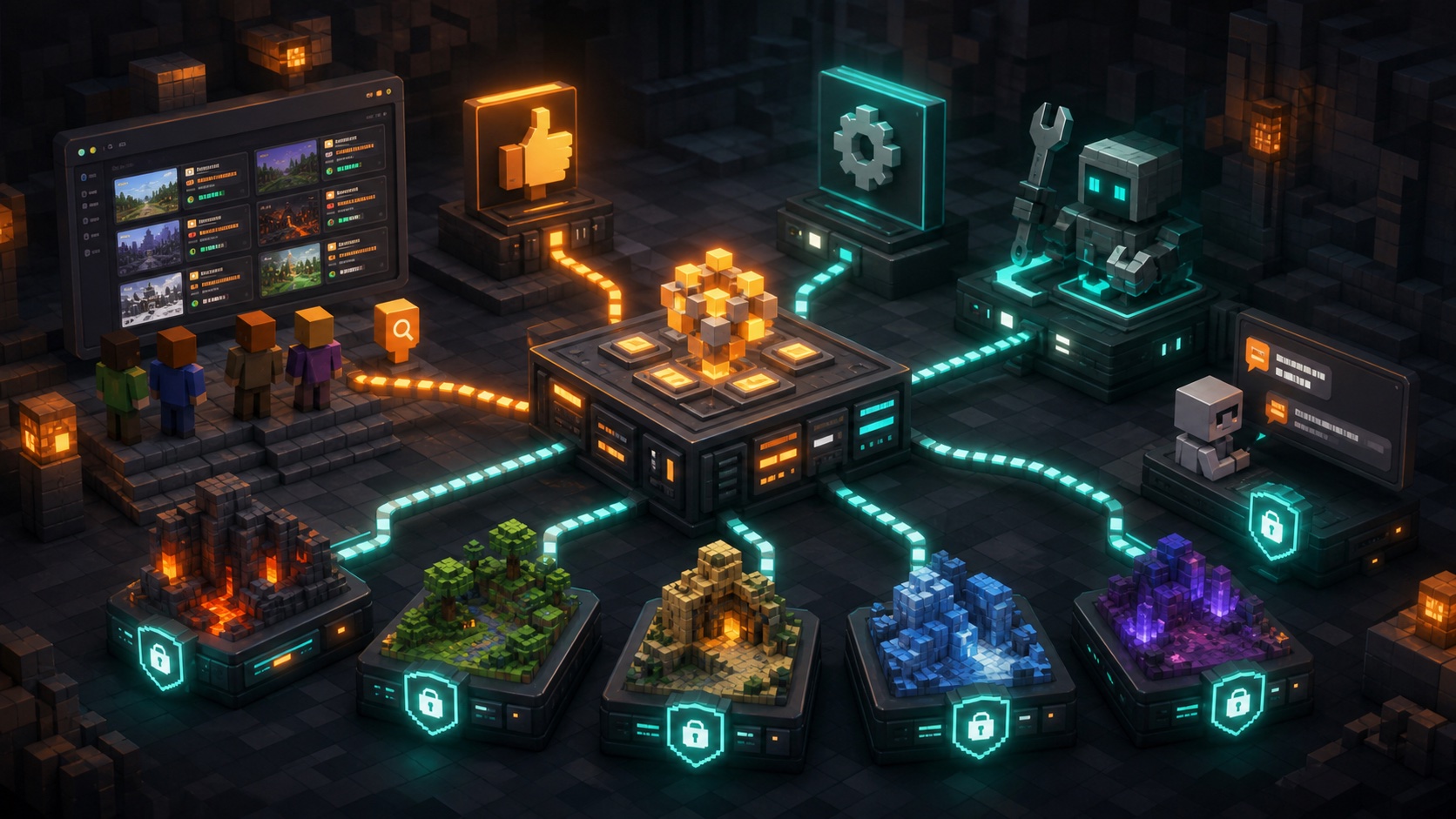
Minekube is exploring trusted Connect Browser discovery, voting, product APIs, MCP automation, and safe in-game AI admins built on Connect endpoint ownership.
Connect gives Minekube a trusted starting point: an endpoint has an owner, a public address, optional custom domains, live reachability state, and a connector path back to the server.
That foundation can support more than ingress. It can support discovery, voting, product APIs, automation, and eventually safe in-game AI admin workflows.
This is the next product direction around Minekube Connect: make public endpoints easier to discover, make operations easier to automate, and keep every powerful action tied to ownership, permissions, and explicit user intent.
Connect Browser should grow from trusted endpoints
Most Minecraft discovery still asks server owners to manually register on a list, prove ownership, copy vote keys around, and run another public listener for rewards.
Minekube can do better because Connect endpoints already have ownership, routing, and status built into the platform.
The Connect Browser already gives players an in-game discovery surface through the Browser Hub, reachable with /browser or by joining minekube.net. Players can discover and join connected endpoints from inside Minecraft.
The next step is to make that discovery surface more intentional. For imported endpoints, owners should have clearer control over how their server appears in public discovery, including verified Connect addresses, attached custom domains where appropriate, and live status from the same source of truth the dashboard uses.
Browser should stay an in-game experience first: browse, join, and return to servers with friends. Search, ratings and reviews, rewards, categories and tags, server history, and future in-world map or portal discovery all fit that direction.
For server owners, the controls should feel concrete:
- "Show my survival endpoint with its verified Minekube address."
- "Prefer this custom domain on the listing."
- "Always show the Minekube
play.minekube.netaddress too." - "Show players that Bedrock is supported."
- "Hide this endpoint from public discovery."
- "Use live endpoint status without removing earned visibility during a restart."
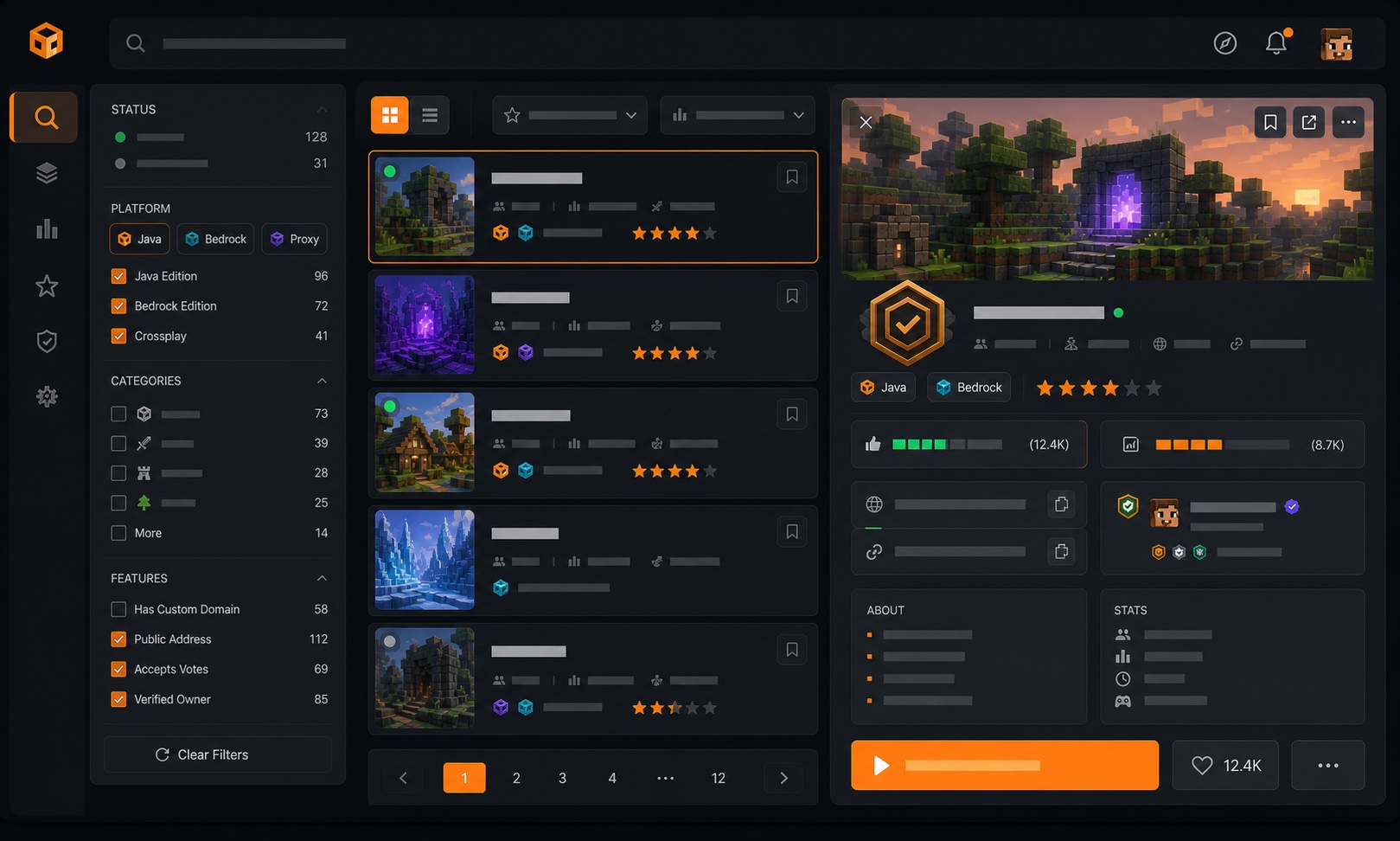
A possible website view for trusted Connect Browser discovery: searchable server cards, live status, verified endpoint data, voting signals, and owner-controlled listing details.
The goal is not to rebuild every old server-list pattern. The goal is to make discovery feel native to Connect.
Voting should fit the Minecraft ecosystem
Voting belongs in Browser, but it needs to fit the ecosystem server owners already use.
Many Minecraft servers already use Votifier-compatible reward flows. A Minekube voting surface should avoid forcing owners to throw that away. Where technically feasible, it should emit compatible vote events or provide adapters so existing reward plugins can continue to work.
The communication layer should use the Connect path where possible instead of requiring another public port. That keeps the operational shape aligned with the rest of Minekube: the backend can stay private, the endpoint is owned, and the product can help with status and diagnostics.
Voting also needs abuse controls before rankings affect discovery. We should not require every player to create a Minekube account just to vote. That would hurt the player experience. But the system still needs basic protections against obvious duplicate voting and ranking manipulation.
The likely shape is a layered approach:
- endpoint ownership and organization import before a server can participate,
- explicit owner opt-in before public listing and voting features affect discovery,
- per-player and per-network rate limits where privacy and platform rules allow,
- cooldown windows similar to existing server-list expectations,
- signals for suspicious bursts or repeated name/IP patterns,
- manual review paths before severe ranking actions,
- and transparent vote history for server owners.
The public listing data can be public. Rankings, vote counts, endpoint status, supported editions, custom domains, and Minekube addresses are already the kind of data a discovery surface exposes. Private diagnostics, billing, tokens, and owner-only controls should stay behind authentication.
Product APIs should come before agent magic
The most technical Minecraft teams already automate everything they can. They build dashboards, Discord tools, deployment flows, moderation helpers, and custom admin workflows. Minekube should meet them there.
Future Minekube product APIs could introduce a broader product model around organizations, imported endpoints, domains, endpoint and session state, usage, plans, discovery data, support context, and operational history.
This is not "AI for the sake of AI." It is infrastructure that should be clear enough for humans, scripts, dashboards, plugins, services, and approved automation to use through the same product surface.
For agents, MCP should be an adapter over those product APIs, not a separate automation backdoor. An agent should receive only the organization, endpoint, and action context it is allowed to use. Sensitive actions should stay reviewable, auditable, and enforced by the same product permissions used by the dashboard and API.
In-game AI admins need strong boundaries
The most exciting version of this is in-game.
A server owner should eventually be able to chat with an AI admin and ask it to do the work a good human admin would normally do:
- "Why are players timing out when joining through my domain?"
- "Check whether Bedrock players are reaching the connector."
- "Prepare a safe restart message and schedule it for the next low-traffic window."
- "Explain why my Velocity forwarding setup is rejected."
- "Generate a whitelist announcement and apply it after I approve."
- "Summarize the last support-relevant errors for this endpoint."
- "Tell me whether voting rewards are reaching my plugin."
Those actions need strong boundaries.
Read-only diagnostics can be easy. Mutating actions should require explicit permission, clear confirmation, audit logs, and safe rollback where possible. High-risk actions should stay out of scope until there is a product policy for them.
The Connect Plugin is important because it runs where server context exists. In the future, that connection can become the bridge for approved product actions: reading endpoint and connector state, checking whether Bedrock traffic is reaching the server, collecting safe diagnostics, preparing setup changes, or asking the server to run a scoped admin action.
The safest agent is not an unscoped script with console credentials. It is an agent working through product permissions, endpoint ownership, explicit scopes, and a plugin connection the server owner chose to install.
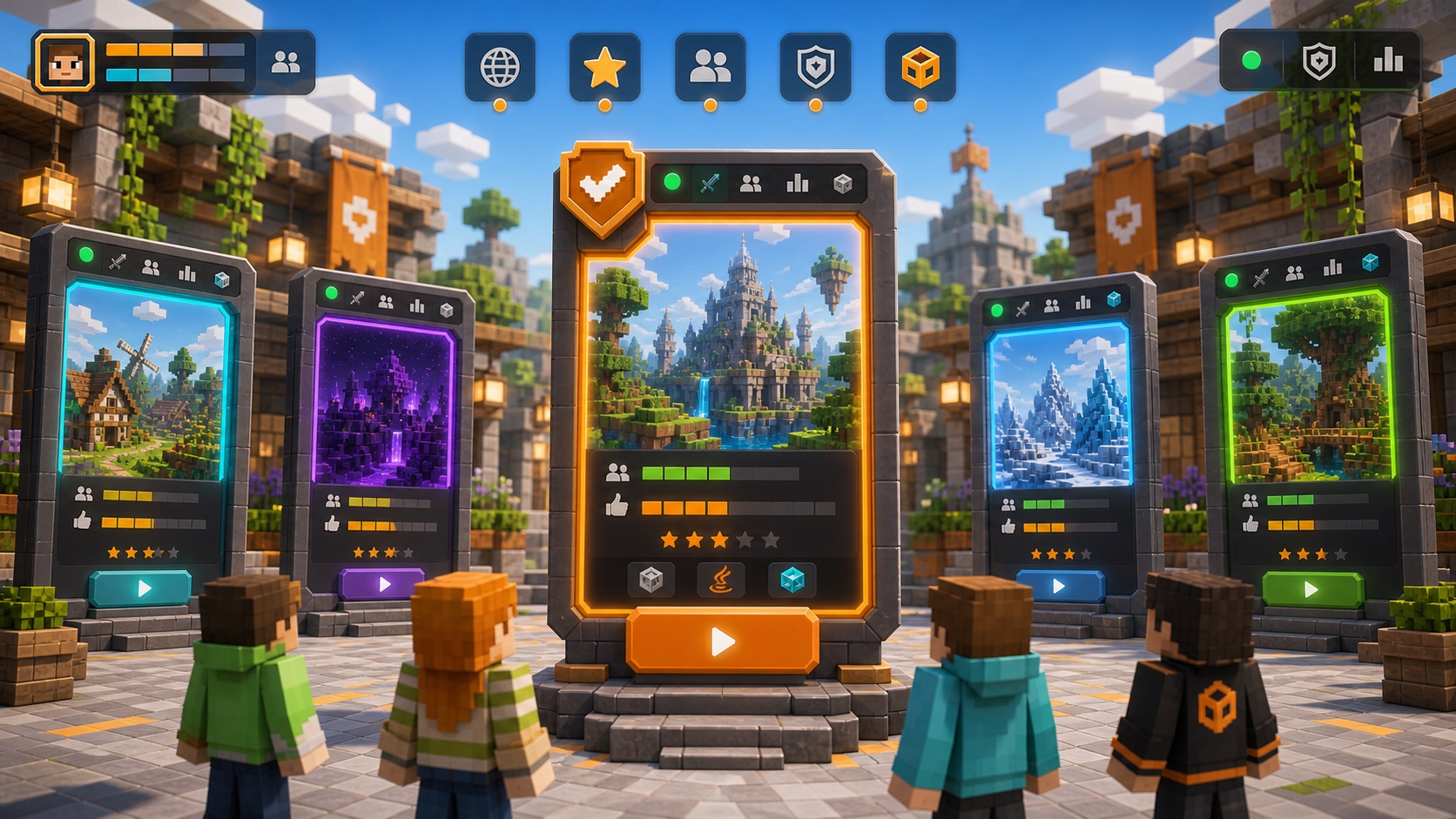
A possible in-game Browser view: trusted endpoint portals, join actions, player-facing discovery signals, and enough context to choose where to play without leaving Minecraft.
What we will build toward
The direction is clear, but we will keep shipping in pieces that server owners can test safely:
- trusted public discovery for imported Connect endpoints,
- owner controls for listing data, custom domains, Minekube addresses, and visibility,
- voting flows that can integrate with existing Votifier-style reward plugins,
- public discovery data that builders can use for dashboards and tools,
- richer product APIs for organization and endpoint operations,
- MCP adapters over those APIs for approved automation,
- and in-game AI admin workflows through scoped Connect Plugin capabilities.
If you run a Minecraft server, proxy, or network, we want to hear what would make this useful without making it risky.
What discovery data should be public? What voting plugin flows must keep working? Which admin actions would you trust an AI to prepare, and which should always require a human? Which operations do you already automate outside Minekube?
Join the Minekube Discord, try Minekube Connect, and help shape the next layer of Browser, APIs, and safe automation.